Leaderboard
728x15
Showing posts with label Sanderling. Show all posts

Saturday's Critters #222

Welcome to Saturday's Critters!

Happy Saint Patrick's Day!


If you love all God's creatures like I do and also like to blog about them and take critter photos this is where you can share your critter post. Link up your post and share your critters, join in with my critter party ! You can share any kind of critters the real ones, pretend ones, statues and paintings, a new or old post!

These are photos from our short trip to Ocean City, Md and Assateague Nat'l Seashore.  I love seeing the wild ponies, we had some great sightings of the ponies and we also saw various birds.


We saw some of the horses while driving thru the campground. One horse walked up to the van's window, I think it was looking for food. We did not see it being fed, that is against the rules.


The Yellow-rumped Warblers were everywhere on the Assateague Island.


A closer look at the Yellow-rumped Warbler,


A Great Blue Heron


The Sanderlings were on the beach at Assateague.


I appreciate and thank everyone who links up their post and for all the wonderful comments this past year ! 


Here is a list of my linky parties;
Also visit:  I'd-Rather-B-BirdinThanks to the gracious host: Anni.

Happy Saturday, enjoy your weekend!

Saturday's Critters # 207

Welcome to Saturday's Critters!

If you love critters like I do and also like to blog about them and take critter photos this is where you can share your critter post. Link up your post and share your critters, join in with my critter party ! You can share any kind of critters the real ones, pretend ones, statues and paintings, a new or old post!

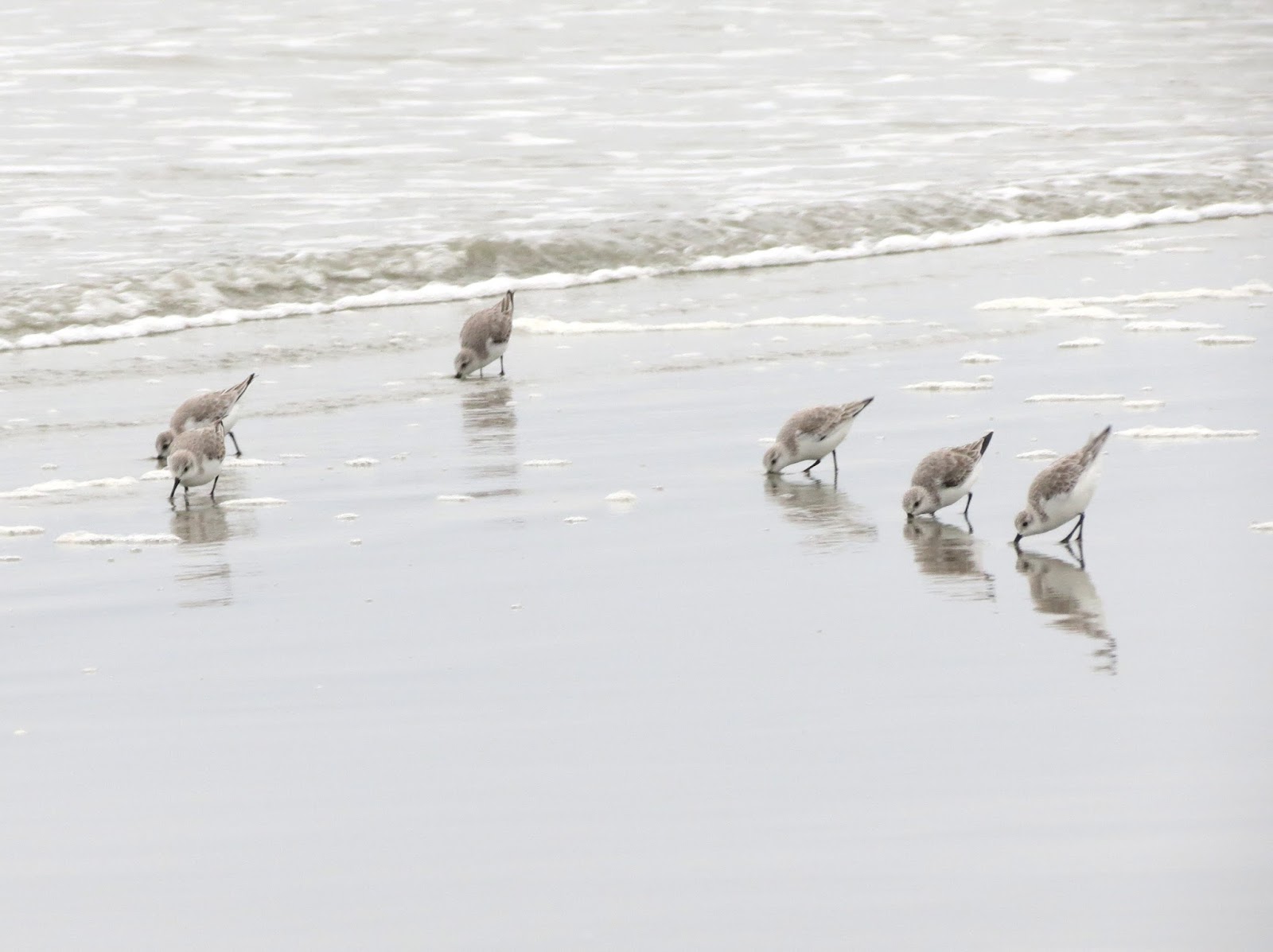
Happy Birthday to me! I hope you will join in with your critters and celebrate my birthday with me. I am sharing more photos from our week at my sister's place. We walked on the beach just about every day. Below are some Sanderlings foraging for food in the surf.


Below are three different bird species, from left to right are the Black-bellied Plover, Willet and a Ruddy Turnstone.


The Ruddy Turnstones can usually be found near the rock jetty.


Not the clearest shot, but I zoomed in on the juvenile Black-bellied Plover. It is a cute bird.


I appreciate and thank everyone who links up their post and for all the wonderful comments! I hope you enjoy my post and photos too!


Here is a list of my linky parties;
Also visit:  I'd-Rather-B-BirdinThanks to the gracious host: Anni.

Happy Saturday, enjoy your weekend!

Well-timed Waders

When you live by the sea, you seem to become very tuned into the rhythm of the tides.  This is particularly the case as a bird photographer as you learn where various wading birds will be at both different states and heights of tide during the winter. As examples there are some beaches where large accumulations of mixed flocks of waders can be found on spring tides, the gathering of Bar-tailed godwits on a local beach during neap tides or the gathering of curlews on a field the high tide period.
The majority of wader photograph tends to be done towards the top of the rising tide as the birds are pushed towards the waiting photographer. Also the bigger tides tend to be favoured as it reduces the area of beach for the birds to use and make them easier to photograph.  However, having said that on the very big spring tides, rocks where the birds typically roost may be inundated and empty. The other key consideration is light direction. For example the beach (a generous phrase for estuarine mud and rocks in the River Mersey channel at the end of my street) can only be photographed during the afternoon a two to three of hours after high tide.

Living by the sea allows you to learn these patterns and use the knowledge to undertake short productive sessions for photographing the birds. This does not work all the time as on occasions the disturbance by other beach users put the flocks to flight.

On the big spring tides at the beginning of the month the appearance of some low late afternoon winter sun in conjunction with the peak of the tide saw me grabbing the camera and taking the 5 minute journey to a beach on the north of the Wirral peninsula. As I hoped there was a narrow strip of beach remaining with one of favourite waders to photograph, the Sanderling, dashing around foraging along the foamy edge of the waves.

 It was just a question then of sitting quietly nearby and letting the birds come to me which is always the best approach. I soon had the birds literally running around close to my feet speeding along the shore looking for marine morsels brought in by each new wave.  The often made comparison of sanderling to clockwork toys as they run around the beach is a very good analogy. They are great fun to photograph as they sprint up and down the tide line.

I had a good 30 or 40 minutes with the birds until a dog walker thought it was hilarious to let his dog rush around and generally terrorise the flock until all the birds departed.
Wading birds, particularly in the winter, are often on a tight energy budget and disturbance of this sort does nothing for their general welfare. However, you cannot expect the majority of people using the beach and coastal footpaths to realise this and all you can do is try and educate where possible.

As I made my way back to the car I spotted a couple of Dunlin together with a few Redshank standing on the rocks, in the diminishing light trying, to avoid the spray of the waves crashing against them and so a took a few photographs before returning home.

So the total length of this session from leaving home to my teabag landing in the mug when I returned was about an hour. An hour well spent in my opinion, as is any time with waders, and such a short session was only possible due accumulating local knowledge from experience.
Swirling Masses

It has been a very good year for waders along my local coast. The birds overwinter here having bred in more northerly latitudes in the spring and early summer. They spend these cold months probing the rich muds that accumulate around the peninsula from the two large rivers that border its sides and discharge into the Irish sea.   Huge flocks, mainly of Knot, mixed with less numbers of Dunlin and Sanderling, have been present and have attracted bird watchers, photographers and the general public to watch the spectacle. Count estimates have been up to 40000 birds gathering together. The best times to watch this are on the big spring tides where beach space is limited by the high water levels for the birds to roost over the high tide period.


The birds gather in tight groups on the shore and are constantly on the move as they jostle up the shore to escape the advancing sea. Periodically they will take flight, sometimes due to a marauding bird of prey looking for an easy meal. The spectacle and sound of these enormous flocks as they lift-off is a memorable experience.  The birds will often then go a short distance out of the sea and swirl in tight formations, flashing dark and light as they twist and catch the light. To capture this amazing sight with still photographs can barely do such a wonder of nature justice.

In the photograph below the island behind is Hilbre Island that sits in the mouth of the Dee Estuary.


The flocks became a popular attraction over the last couple of months and always put on a superb display for onlookers the look on in awe.

The roosting periods are important for the birds as they operate on tight energy budgets during the winter months. Unfortunately they do not have exclusive use of the beach and are frequently subject to disturbance by walkers and dogs. There has been a concerted effort by the local the bird watching community and photographers, combined with a warden scheme to educate the public on the importance of allowing the birds some space and peace. However, there are still people who pay no attention and happily let there dog run in to the flocks or bird watchers or photographers from outside the local area who seem to think walking up to birds will somehow not disturb them. If you visit on the large tides there actually is no need to step on to the beach at all as the birds are brought right up to you by the incoming tide allowing plenty of photo opportunities.


The photograph below is part of the flock, tightly gathered, and waiting for the advancing tide. As the beach is so flat the tide advances with dangerous speed on these large tides and a few minutes after this was taken the sand was covered.


I do not often bother photographing flocks as I prefer to target individuals or small groups. I find flocks quite difficult although that may be down to lack of practice. With flocks of this size it is more like landscape photography that includes a large flock of birds. I suppose you could call them 'birdscapes'. The photographs in this post are a selection from two visits that I made, one in December and one earlier this month. The weather conditions during the January visit were beautiful with the rare winter treat of clear skies and light winds.


On the beach the birds gather into extremely tight flocks and occasionally there will be a wave of movement through it with all the birds lined up and facing the same directions. This creates waves of patterns through the gathered birds which is a delight to watch.


Places to land are always at a premium. When the flock lifts off at close range there often seems to be more wings than air in which to flap them. These are photographs that are asking to be made in to a very difficult and frustrating jigsaw puzzle.


I know these photographs really have not done the dynamic nature of these a flocks justice but hopefully will give you a small impression of this amazing gathering of nature. A real treasure to have on your doorstep.


Leaderboard